

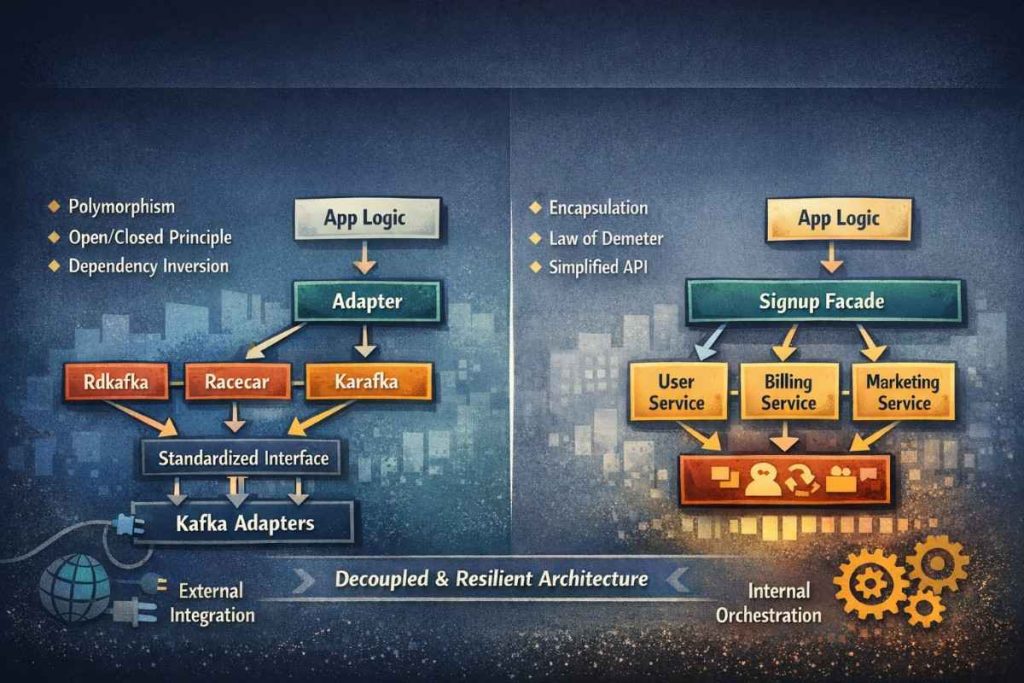
In high-throughput Rails ecosystems, technical debt often accumulates at the boundaries—where core logic meets volatile third-party drivers or sprawling internal subsystems. As an application matures, the cost of change increases exponentially if the business logic is tightly coupled to specific implementation details. To maintain a decoupled, testable, and resilient architecture, senior engineers employ structural design patterns to manage these integration points. While both the Adapter and Facade patterns involve “wrapping” code, they operate at different layers of the stack.
The Adapter is a tool for reconciliation, ensuring that disparate interfaces can speak the same language. The Facade is a tool for abstraction, providing a unified gateway to a complex web of dependencies. Mastering the distinction between them is the difference between a brittle codebase and one that evolves gracefully.
The Adapter Pattern: Interface Reconciliation
The Adapter pattern addresses Interface Incompatibility. It acts as a structural bridge, ensuring that a class with a disparate interface can interoperate with a client expecting a standardized internal protocol.
Core OOP Principles Followed
- Polymorphism: The Adapter allows different “Adaptee” classes (e.g., different Kafka drivers) to be treated as the same type by the client through a common interface.
- Open/Closed Principle: We can introduce new adapters for new third-party libraries without changing the existing client code.
- Dependency Inversion: High-level modules do not depend on low-level library details; both depend on the abstract interface defined by the Adapter.
Use Case: Abstracting Kafka Consumers via adapter
In a Rails event-driven architecture, we might start with a simple gem like Racecar, but eventually need the high-performance throughput of rdkafka or the comprehensive feature set of Karafka. Hardcoding these library-specific methods into our background workers creates a “vendor lock-in” at the code level.
# The Target Interface: What our Rails app expects (Standardized)
class MessageConsumerAdapter
  def subscribe(topic); raise NotImplementedError; end
  def fetch_batch; raise NotImplementedError; end
end

# Adapter for rdkafka (Low-level, C-based performance)
class RdkafkaConsumerAdapter < MessageConsumerAdapter
  def initialize(config)
    # The 'Adaptee' is the low-level Rdkafka client
    @client = Rdkafka::Config.new(config).consumer
  end

  def subscribe(topic)
    @client.subscribe(topic)
  end

  def fetch_batch
    # Rdkafka uses a specific message object; we extract the payload
    message = @client.poll(100)
    message ? [message.payload] : []
  end
end
Technical Insight: The Adapter encapsulates the “impedance mismatch” between our domain and the library. It allows us to swap infrastructure without touching a single line of business logic.
The Facade Pattern: Complexity Abstraction
While the Adapter fixes naming and signatures, the Facade fixes cognitive load. It provides a simplified, high-level entry point to a subsystem, masking the interactions of multiple classes behind a single, expressive method.
Core OOP Principles Followed
- Encapsulation: The Facade hides the complexity of the subsystem and the “messy” interactions between multiple objects from the client.
- Principle of Least Knowledge (Law of Demeter): The client only communicates with the Facade, reducing the number of objects it needs to know about.
- Abstraction: It provides a high-level view of a complex process, focusing on what the system does rather than how each individual class contributes to it.
Technical Implementation: The Signup Facade
As Rails applications grow, “Service Object Sprawl” becomes common. A single business action, such as UserSignup, often requires orchestrated interaction between several decoupled domains.
class SignupFacade
  def initialize(user_params)
    @params = user_params
  end

  def execute
    User.transaction do
      # Persistence, Billing, and Marketing orchestrated behind one wall
      user = User.create!(@params)

      BillingService.create_customer(user)
      MarketingSync.subscribe(user.email)
      CacheManager.prime_user_data(user.id)

      user
    end
  rescue ActiveRecord::RecordInvalid => e
    ErrorTracker.notify(e)
    nil
  end
end
Technical Insight: The Facade is an “entry point.” It does not necessarily follow a pre-existing interface like the Adapter; instead, it defines a new, developer-friendly API that serves as a shortcut for the application.
Comparative Analysis: Adapter vs Facade
| Metric | Adapter Pattern | Facade Pattern |
| Primary Intent | Interoperability: Interface conversion. | Usability: System simplification. |
| Interface | Follows a required, standardized interface. | Creates a new, simplified interface. |
| Complexity | Wraps a single object/class (usually). | Wraps many objects/classes. |
| OOP Strength | Strong Polymorphism and DIP. | Strong Encapsulation and Abstraction. |
| Typical Context | 3rd-party drivers (Kafka, Payments etc.). | Internal orchestration (Signup, Checkout). |
Final Architectural Verdict
Implementing these patterns is not about adding boilerplate; it is about establishing clean boundaries. In a professional Rails environment, we deploy Adapters when we need to insulate our application from external volatility. By wrapping a Kafka driver or a Payment Gateway, we ensure that the “outside world” cannot force us to rewrite our core logic.
Conversely, we deploy Facades to reduce internal complexity. As the internal graph of service objects grows, the Facade prevents our controllers and models from becoming a “Big Ball of Mud.” It provides a single, reliable handle for complex multi-step operations.
By layering these patterns, we move toward a Hexagonal Architecture (Ports and Adapters). Our core business logic remains pure and easy to test, while all external or complex interactions are managed by specialized structural guards. This level of foresight transforms a codebase from a legacy liability into a flexible asset.
Further Reading & References
- Big Ball of Mud – Official Paper (PDF) by Brian Foote and Joseph Yoder.
- Summary by Coding Horror: A more digestible breakdown of the paper’s 7 architectural pathologies.
Explore more articles and insights on software engineering and technology at Rently Engineering.
