

|
Getting your Trinity Audio player ready...
|
When building modern web applications, managing user authentication is a delicate balancing act. You want your API endpoints locked down tight so that unauthorized parties can’t sneak through. At the same time, you don’t want to force your users to re-enter their credentials every 15 minutes.
Enter the power couple of stateless authentication: Access Tokens and Refresh Tokens.
While both serve the overarching goal of verifying who a user is, they play completely different roles in your system’s architecture. Let’s break down how they work together to create a secure, fault-tolerant authentication strategy.
The Core Dilemma: Short-Lived Security vs. Long-Lived Convenience
To understand why we need two tokens instead of one, consider the fundamental trade-offs in stateless authentication using JSON Web Tokens (JWTs):
- If a token lives forever: A user stays logged in forever (great UX), but if an attacker steals that token, they have permanent, unrestricted access (disastrous security).
- If a token expires in 10 minutes: An attacker only gets a 10-minute window of abuse if a token is stolen (great security), but your user gets booted back to the login screen dozens of times a day (miserable UX).
We need a way to revoke access quickly on compromise while keeping legitimate sessions alive smoothly.
Meet the Players
1. The Access Token (The Temporary Pass)
- Lifetime: Short (e.g., 5 to 15 minutes).
- Role: Grants authorization to request protected resources/APIs.
- Storage: In-memory (JavaScript variables) or secure short-term state.
- Characteristics: Self-contained (contains user IDs, roles, and scope) and sent in the
Authorization: Bearer <token>header of every API call.
2. The Refresh Token (The Master Key Voucher)
- Lifetime: Long (e.g., 7 days to 30 days).
- Role: Used solely to request a new Access Token when the current one expires.
- Storage: Strictly in an
HttpOnly,SameSite,Securecookie to protect against XSS (Cross-Site Scripting). - Characteristics: Opaque string or signed JWT stored in a persistent database/Redis store on the backend, allowing immediate server-side revocation.
The Authorization Choreography
Here is how the token rotation flow works under the hood:
Step-by-Step Flow:
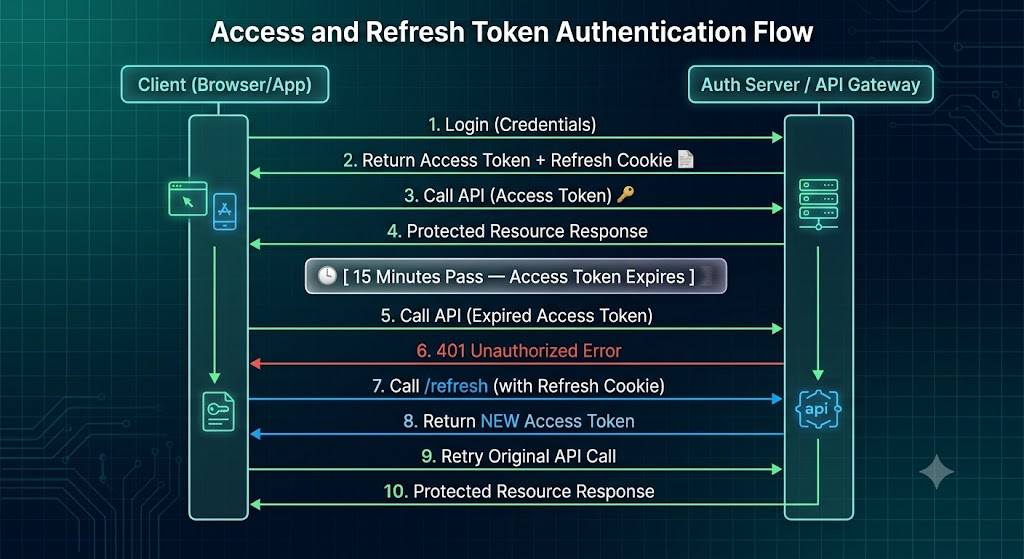
- Login: User submits credentials to
/login. - Issuance: Backend authenticates credentials and returns:
- Access Token in the response JSON payload.
- Refresh Token in an
HttpOnlysecure cookie.
- Regular Requests: Frontend uses the short-lived Access Token in headers to query API endpoints.
- Token Expiration: The Access Token expires after 15 minutes. The API responds with a
401 Unauthorized. - Silent Refresh: An Axios/Fetch interceptor catches the
401, automatically hits the/refreshendpoint using the HttpOnly Refresh Token cookie, receives a new Access Token, and retries the original failed request seamlessly—without the user ever noticing.
Token Comparison: Quick Reference
| Feature | Access Token | Refresh Token |
| Primary Purpose | Accessing protected endpoints | Obtaining new access tokens |
| Lifespan | Very Short (5–15 mins) | Long (Days to Months) |
| Storage Location | Memory / State | HttpOnly Cookie / Keychain |
| Sent With | Every API request header | Only requests to /refresh |
| Revocation | Hard (Stateless, wait for expiration) | Easy (Stored & checked in Database/Redis) |
| Risk If Leaked | Low exposure window | High severity (must implement token rotation) |
Advanced Defense: Refresh Token Rotation & Theft Detection
What happens if an attacker manages to steal a Refresh Token? To handle this chaos, implement Refresh Token Rotation:
- Every time a Refresh Token is used to get a new Access Token, invalidate the old Refresh Token and issue a brand-new Refresh Token alongside the new Access Token.
- Maintain a “family” or chain ID for the tokens in your database.
- Automatic Lockdown: If a previously invalidated Refresh Token is received at
/refresh(indicating a replay attack by a malicious actor), immediately revoke the entire token family for that session.
Key Takeaways for System Architects
- Never store long-lived tokens in
localStorage: It is vulnerable to Cross-Site Scripting (XSS). - Keep access tokens lean: Don’t bloat JWT payloads with massive user objects—keep them small for faster network roundtrips.
- Build silent retry logic early: Use API interceptors to handle
401errors and refresh tokens transparently so client applications don’t stutter. - Fail closed: If a token anomaly occurs, revoke the session immediately and force re-authentication.
By separating authentication into short-lived access and revocable refresh mechanisms, you achieve both rigorous security and a frictionless user experience.
Further Reading & References
- Auth0: Token Best Practices https://auth0.com/docs/secure/tokens/token-best-practices
- OWASP: Session Management Cheat Sheet https://cheatsheetseries.owasp.org/cheatsheets/Session_Management_Cheat_Sheet.html
Explore more articles and insights on software engineering and technology at Rently Engineering.
