

|
Getting your Trinity Audio player ready...
|
The Era of the Manual Laborer
Before the AI revolution, my life as a Ruby on Rails engineer was a quiet, lonely marathon. I remember the weight of the silence in my room, broken only by the rhythmic, hollow click of my mechanical keyboard. In those days, I wasn’t just a builder; I was a professional “searcher.”
If I hit a wall with a complex database migration or a cryptic RSpec failure, my ritual began: a desperate, multi-tab marathon through official documentation, the dusty, often outdated corners of StackOverflow, and the opinionated threads of Quora. I was a “patch-worker.” I would find a snippet here and a logic block there, trying to stitch them together into something functional. My brain was a cluttered library of syntax and “how-to” guides. I was a manual laborer of logic, spending 70% of my day just trying to remember how things worked.
When a new feature request landed on my desk, the clock became my enemy. I would spend hours—sometimes entire days—agonizing over the “best” architectural solution, only to have it picked apart in peer reviews. It was a cycle of research, doubt, and slow execution. Time wasn’t just money; it was the friction that kept my best ideas grounded.
The First AI Spark: Beyond the Ghost in the Machine
Late in 2024, the atmosphere of my workspace changed. I integrated GitHub Copilot into VS Code, and initially, it felt like a ghost in the machine—a “smart” autocomplete that possessed an eerie knack for finishing my sentences. It knew I wanted to type User.find_by(email: ...) before my fingers even reached for the keys.
Then, curiosity led me to a Microsoft certification on Copilot. That was the moment the door didn’t just crack open—it swung off its hinges. I realized I had been using a supercar to drive to the grocery store. Copilot wasn’t just a predictive keyboard; it was a multi-modal engine.
I stopped searching the web for how to handle complex Rails edge cases and started using Ask Mode. The answers were instant and contextual to my specific codebase. I discovered Edit Mode, where I could describe a change—“Convert this entire controller to use the new API standard”—and watch the logic rewrite itself. Suddenly, the hour-long struggle to “un-spaghetti” a piece of legacy code was reduced to a thirty-second conversation. I wasn’t just writing code anymore; I was directing it.
The Friend in the Machine: The Art of the Argument
By early 2025, the relationship changed. GitHub Copilot introduced Agent Mode, and suddenly, I wasn’t just using a tool; I was working with a colleague. This was pair programming in its purest form. I would sit with my morning coffee, open a blank file, and start a dialogue.
I stopped typing code and started typing intent. I’d tell it: “We need to migrate our billing logic to support multi-currency, but I want to keep the database schema backward compatible.” Then, the magic—and the friction—began. My “friend” would generate a solution. Sometimes, I’d look at the code and scowl. “No, that’s too verbose,” I’d argue. “We’re using Ruby 3.3; we can use Data objects here instead of OpenStruct.” The Agent would pause, acknowledge the correction, and rewrite the logic. Other times, it would push back, suggesting a design pattern I hadn’t considered—perhaps a Strategy Pattern where I was about to write a messy if/else block.
We were in a constant tug-of-war. Sometimes I won; sometimes the AI convinced me that its way was more “Railsy.” In those moments, I realized we were both learning. It was a lovely, strange synergy of my natural intuition and its vast, artificial library of patterns.
Mastering the AI Language of Vision
But I soon learned that a “friend” only gives you what you’re clear enough to ask for. To truly unlock this partnership, I had to stop barking commands like a boss and start providing visions like a leader. A Prompt Engineering specialization completely reframed the SDLC, teaching that a great prompt is almost identical to a well-written Jira ticket—it requires structure, clarity, and boundaries. Instead of shouting commands, a new three-pillar framework became the standard for every interaction:
- Persona: “You are an experienced Ruby on Rails (RoR) architect with a strong understanding of MVC principles…”
- Context: “Given a description of a new feature, generate the best architectural approach for implementation within our legacy monolithic app…”
- Description: “Adhere to Rails conventions. Outline key considerations, placement of components, and interactions. Prioritize maintainability and scalability.”
By mid-2025, the results were staggering. The “Search-and-Patch” days were dead. Features that used to haunt my calendar for months were being polished and pushed in mere weeks. My productivity hadn’t just ticked up; it had doubled.
The Context Gap: The Final Wall
However, speed has a price. As I moved faster, we hit an invisible wall: The Context Gap. Because I was moving at such a high velocity, the Agent sometimes started to lose the “thread.”
Critical details often went missing. A specific helper method written just yesterday in a deep folder remained invisible to the tool. Development team taboos against certain gems or patterns were ignored. Guessing replaced precision, and the first signs of hallucination began to surface.
I was flying at 30,000 feet, but my co-pilot was sometimes losing the map. I realized that to reach 10x, I didn’t just need a smarter friend—I needed to give that friend a permanent memory.
Building the Digital Brain
To bridge the Context Gap, I realized I had to stop treating my AI friend like a temporary visitor and start treating it like a brilliant, long-term partner who simply needed a better manual.
Working with a peer, I discovered the power of the copilot-instructions.md file. We poured the entire DNA of our project into it: our architectural quirks, preferred gems, testing standards, and our team’s “taboos.” This file became the “Brain” of our environment. Hallucinations dropped to near zero because the Agent finally had a source of truth.
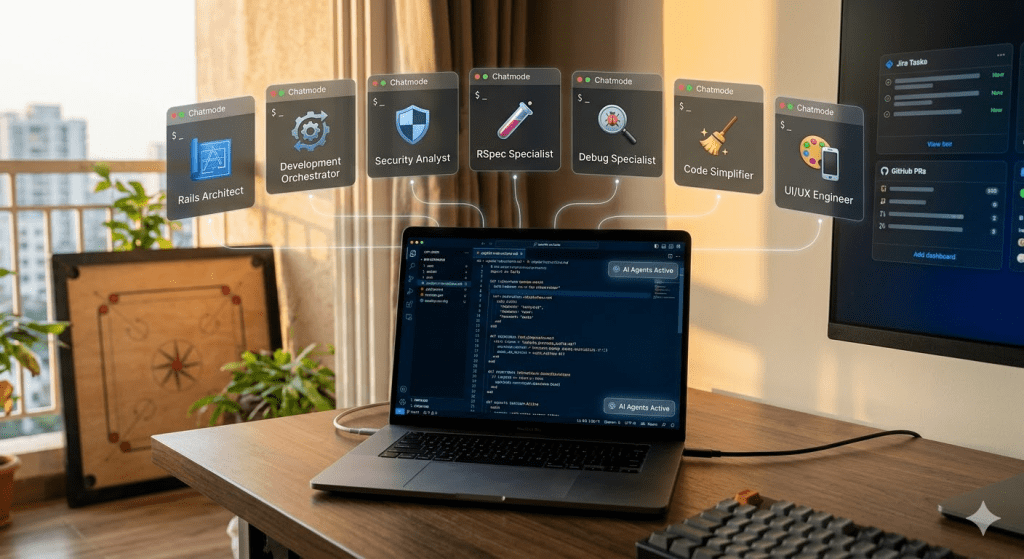
But we didn’t stop at a single brain. We built a Digital Department. I created custom personas called Chatmodes—what we now call Agents—each trained to master a specific slice of the SDLC:
- The Rails Architect: My right hand for high-level system design.
- The Dev Agent: The project manager that keeps the feature flow moving.
- The Security Analyst: A dedicated shield hunting for vulnerabilities.
- The RSpec Specialist: The guardian of our test suite.
- The Debug Specialist: A surgical specialist for root-cause analysis.
- The Code Simplifier: The “clean-up crew” for readable, scalable code.
- The UI/UX Engineer: Focused on professional, responsive interfaces.
Crucially, throughout this radical acceleration, the quality of development never degraded. In fact, the opposite occurred. By offloading the mechanical burden of syntax to these specialized agents, the focus shifted toward rigorous architectural validation and defensive programming. With the RSpec Specialist and Security Analyst acting as autonomous quality gates, every line of code now adheres to a higher standard than manual processes could consistently achieve. The newfound bandwidth allowed for leading with a precision that was previously impossible, ensuring that high-velocity delivery and high-fidelity engineering are no longer mutually exclusive.
2026: The Era of AI Innovation
Now, as we move through 2026, the world looks entirely different. My 2x productivity has exploded into 10x. Engineering has become “fun” again because the mechanical “how” has been replaced by the creative “what.”
Through the Model Context Protocol (MCP), my agents are connected to everything—from Jira to GitHub. My day now has a different rhythm. I can look at a Jira task and tell my team of agents: “Implement this.” While I step away to play a game of carrom or have a coffee with my human colleagues, my digital team is at work. They read requirements, plan architecture, write Ruby code, draft tests, and generate documentation.
When I return, the work is waiting for my review. They even create the Pull Requests and perform the first layer of code review themselves. I’ve stopped being a “patch-worker.” Today, I am an innovator. I spend my days researching and thinking about business logic. My team handles the rest. Life has changed to Grok, Claude, and GPT—and it is, quite simply, magic.
The question is no longer “Can AI code?” but “How well can we lead our AI team?”
The Map and the Compass: How to Begin Your Own Journey
- https://learn.microsoft.com/en-us/training/modules/introduction-to-github-copilot/
- https://www.coursera.org/specializations/prompting-essentials-google
- https://github.com/features/copilot/tutorials
Explore more articles and insights on software engineering and technology at Rently Engineering.
