

|
Getting your Trinity Audio player ready...
|
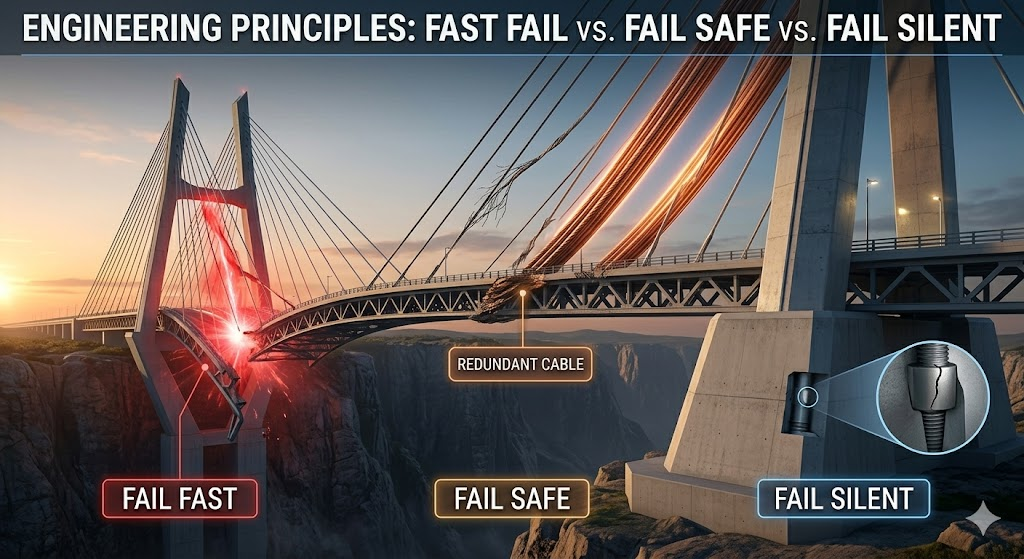
Fault Tolerance in distributed architectures and safety-critical embedded systems is not an anomaly; it is a baseline environmental condition. Network partitions occur, hardware degrades, and sensors return malformed payloads. The goal of robust software architecture is not to prevent failure, but to choreograph exactly how the system behaves when it encounters an invalid state.
System resilience relies heavily on three error-handling paradigms: Fail Fast, Fail Safe, and Fail Silent. Choosing the wrong paradigm can lead to non-deterministic behavior, silent data corruption, or catastrophic system crashes. To illustrate how these paradigms interact in a production environment, we will examine them through the lens of a highly complex, safety-critical application: an Autonomous Vehicle (AV) control system.
1. Fail Fast: Immediate Exception Propagation
The Fail Fast principle dictates that a system or component should immediately halt operation and propagate an error the moment it detects an unexpected state, invalid input, or failing dependency. It strictly prioritizes state integrity and deterministic behavior over availability.
By failing fast, we prevent the system from operating on corrupted data, avoiding cascaded failures downstream where the root cause becomes nearly impossible to trace. This is a fundamental component of achieving high-level fault tolerance.
- The Scenario: The front-facing LIDAR array begins returning malformed byte arrays due to a hardware malfunction.
- The Implementation: The input validation layer checks the payload checksums and strict data typing. Upon detecting the anomaly, the module does not attempt to “guess” or smooth over the data. It immediately throws a fatal exception.
- The Architectural Value: In an AV, guessing environmental data is lethal. This immediate exception forces the supervisor process to instantly disengage autonomous mode and lock the steering column back to the human driver.
2. Fail Safe: Graceful Degradation
Fail Safe is the practice of designing a system to intercept underlying errors and transition into a degraded but safe operating mode. While Fail Fast is applied at the micro-component level, Fail Safe is an application-level orchestration strategy. It prioritizes system availability and user safety by utilizing fallback mechanisms to maintain fault tolerance.
- The Scenario: The vehicle drives through a tunnel, resulting in a complete network partition. The HTTP request to the cloud-based routing API times out.
- The Implementation: The routing orchestrator catches the
TimeoutException. Instead of propagating this error to the main drive loop (which would stop the car in the middle of traffic), it shifts to static routing using localized, cached map data. - The Architectural Value: The system absorbs the failure of a non-critical dependency. It safely degrades its feature set—alerting the driver that traffic updates are unavailable—while maintaining the core functionality of driving the vehicle safely.
3. Fail Silent: Exception Swallowing
Failing Silent occurs when an application catches an error and intentionally continues execution without altering the state or alerting the user. In core logic, this is an egregious anti-pattern; however, it has a narrow architectural niche: non-critical, strictly asynchronous side-effects where the core thread’s performance is paramount.
- The Scenario: A background telemetry daemon tries to send non-blocking UDP packets regarding cabin temperature to a manufacturer’s server, but the server is down (503 Service Unavailable).
- The Implementation: The daemon catches the exception, perhaps increments an internal “dropped packet” counter, and explicitly swallows the error to move to the next cycle.
- The Architectural Value: Telemetry is disposable compared to vehicle operation. By failing silent, the architecture ensures that trivial background tasks never interrupt critical real-time execution paths, maintaining overall fault tolerance.
Architectural Synthesis: Layering the Paradigms
A resilient system does not rely exclusively on one strategy; it stacks them hierarchically.
| Paradigm | Architectural Domain | Objective |
| Fail Fast | Low-level interfaces, I/O boundaries, state mutations. | Prevent state corruption; ensure determinism. |
| Fail Safe | Orchestrators, macro-services, UI layers. | Maintain availability; graceful degradation. |
| Fail Silent | Fire-and-forget workers, non-critical metrics. | Protect core threads from trivial interruptions. |
The Engineering Takeaway: Design our underlying modules to Fail Fast with explicit, strongly-typed errors. Design our high-level orchestrators to catch those errors and Fail Safe to protect system availability. Reserve Fail Silent exclusively for operations where failure genuinely does not matter. Effectively balancing these three is the only way to achieve true fault tolerance in complex systems.
Further Reading & References
- Jim Shore: Fail Fast – How to use assertions to stop bugs before they propagate.
- Martin Fowler: Circuit Breaker – Managing system availability when external services fail.
- Design patterns for self-healing systems – Concrete patterns like Retries, Fallbacks, and Throttling.
Explore more articles and insights on software engineering and technology at Rently Engineering.
Related posts:
